current
issue > summer
2011 contents
It’s
dark and crowded in
the basement of the
Wellesley Historical
Society, just as you’d
expect the tombs of
the town museum to
be. You make your
way down creaking
steps, around a hulking
oil tank and under
low-hanging pipes,
then turn sideways
to edge between heavy
trunks and racks of
gowns and crates piled
to the ceiling. To
the right, you reach
worn wooden cabinets
crammed together in
a tight space dimly
lit by a distant overhead
light.
And
then you pull open
one of the cabinet’s
drawers and everything
changes.
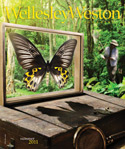
In
a ferocious blaze
of colors drenched
with impossibly bright
internal sunlight,
in patterns that would
make Jackson Pollock
proud, the nearly
1,500 butterflies
and moths nestled
inside the drawers
do more than illuminate
the shadowy room.
Lighter than a breath,
more iridescent than
a tropical rainbow,
they look as if they
had just fluttered
into the basement
a soft moment ago.
Yet
they have rested in
their cases for more
than a century. Living
only a few brilliant
days in the world,
these lepidoptera
have been preserved
without a fading of
their glory by one
astounding Wellesley
family.
At
the turn of the 20th
century, the legend
of the Dentons reached
around the world.
They won the gold
medal at the 1900
Paris Exhibition;
they traveled four
continents lecturing,
collecting, and exhibiting.
Parisian couturier
Worth based a line
of gowns on their
displays; Louis Comfort
Tiffany tried to buy
their secrets for
his jewelry and stained-glass;
the scientific world
heralded and awarded
their innovations.
Their exhibits took
up permanent homes
in millionaires’ estates,
museums, and universities
throughout Europe
and the United States.
 |
Catopsilia
Philca (Brasil)
|
And
yet now, out of the
hundreds of thousands
of little beauties
that enchanted the
Victorian and Edwardian
eras, the ones that
slumber in the Historical
Society may be the
only Denton butterflies
left to be seen. Who
was this family, and
how did they achieve
their stunning success?
The
legend starts with
William, born in 1823.
Iconoclastic, rebellious,
utterly individualistic,
he was a self-taught
scientist, lecturer,
naturalist, collector,
and explorer. He would
have been the quintessential
American icon: except
that he was British.
But he then became
more American than
the Americans, because
in 1848, after he
lost his London teaching
job for his radical
and “heretical” beliefs,
this unschooled boy
who had become a maverick
preacher at age 16
abandoned his native
land in search of
the vast intellectual,
religious, cultural,
and physical freedoms
beckoning from across
the ocean.
Soon
he was even driven
from his West Virginia
teaching job by the
threat of mob violence
for his passionate
abolitionist views,
so he fled to anti-slavery
Ohio, where he was
once asked to provide
safe escort from an
angry crowd to Elizabeth
Foote, known for her
progressive writings,
her daring to take
a “man’s” job
as a typesetter, and
her shocking propensity
for wearing bloomers.
 |
William
Denton, Sr.
|
These
two fruitfully kindred
spirits soon joined
forces, marrying and
launching the kind
of extraordinary Mark
Twain/Horatio Alger
life possible in this
bold progressive era.
They traveled the
country writing, speaking,
absorbing. There didn’t
seem to be a subject
William did not have
an interest in, or
an opinion on. He
published and lectured
about geology, scientific
enlightenment, women’s
rights, free-thought,
spiritualism, and
industrial and societal
reforms. He engaged
in a week-long debate
about evolution with
future President James
Garfield. A lifelong
rabid teetotaler,
on his non-stop lecture
tours he railed passionately
in favor of temperance.
Inspired by his fascination
with the clairvoyant
world, he invented
a new field called “Psychometry,” and
set about to convince
others that a spiritualist
(such as Elizabeth)
could read the memories
of everything that
a stone or fossil
had ever seen.
For
the next 10 years,
they were an inseparable
team on the small-town
itinerant lecture
circuit, one year
walking 9,000 miles
to deliver 255 lectures.
Along the way they
collected pieces of
the natural world
compulsively—minerals,
gems, granite, bird
skins, fresh water
pearls, fossils—and,
of course, butterflies.
When
it came time to create
the next generation
of insatiably curious
naturalists, William
and Elizabeth bought
a homestead, but for
the rest of William’s
compulsively single-minded
life of exploration,
he never settled down.
In 1867, they bought
13 acres of cleared
cornfield stretching
north from today’s
St. Andrew’s
Church, in what was
then the rural, purely
country village of
West Needham, now
Wellesley. The land
was reached by a rutted
path known as Orchard
Street, later named
Denton Road. They
built one of the largest
homes in the area
at what would become
number 11, and set
about raising five
children who spent
most of their days
exploring the natural
world around them — catching
fish with their bare
hands in Waban Brook;
finding Indian arrowheads
and large stone pestles
in the fields that
would become the Nehoiden
Golf Course; collecting
bird eggs along Fuller
Brook; always coming
back with bits and
pieces of nature to
study and dissect
and draw and discuss.
 |
Sherman
Denton
|
The
four boys walked to
school on Central
Street and joined
the town band; the
daughter had Katharine
Lee Bates as a teacher.
But when they became
teenagers, William
took them out of school
and enlisted them
as his magic lantern
assistants on his
itinerant tours, which
now lasted for years
at a time. In 1881,
just as Wellesley
became a town, William
and sons Sherman and
Shelley left for a
three-year tour of
Australia, New Zealand,
and Tasmania. While
there, in 1883 William
couldn’t
resist a chance to
plunge deep into the
intoxicating “terra
incognita” of
New Guinea. Stricken
with jungle fever,
he couldn’t
make it back to his
sons who waited in
a coastal village,
and he died 15 miles
away from reaching
them. He was 60 years
old.
His
children inherited
his restless natural
curiosity, but also
his massive bills
and responsibilities.
Bringing back with
them tens of thousands
of pounds of fossils,
bird eggs and skins,
fish, snakeskins,
insects, stones, and
butterflies, they
desperately had to
find a way to combine
their father’s
legacy with the practical
demands he had never
mastered.
The
five children, four
wives, mother, and
three grandchildren
bonded into an extraordinary
single unit, working
as one to share their
lives and work. They
all lived on the family
property, building
their own homes and
the still-standing
barn at number 72
to store their accumulated
treasures. Upon William’s
death, Sherman, the
oldest at 27, turned
his family’s
undisciplined collecting
into a focused and
thriving business.
He looked at the thousands
upon thousands of
butterflies which
they had shipped home
and developed and
patented a process
to preserve these
fragile bits of beauty.
Now the Dentons could
bring a kind of immortality
to what had before
been merely momentary
glimpses of a rare
loveliness.
 |
Euphaedra
Sarcopterfa
(Africa)
|
Sherman’s
design was innovative,
leading The
New York Times in 1895 to gush
over what was called
the “Denton
Mount”: “The
wings of the fragile
creatures rest against
a background like
alabaster, showing
every minute curve
and scallop. Yet they
are protected from
dust and pests, and
may be handled without
fear of breakage.” Until
now, researchers had
stretched butterflies
into awkward shapes,
impaled them with
pins, and doused them
with foul chemicals,
and yet they still
quickly faded and
crumpled. Sherman’s
plaster mount cradled
the fragile bodies
in a tender, natural
embrace, encased them
in glass, and transformed
them into centerpieces
of scientific and
cultural delight.
That
same year Willie and
Winsford transformed
the barn into headquarters
for “Denton
Brothers Butterflies” and,
using Sherman’s
creation and the immense
amount of butterflies
the family had brought
back over the years,
went into business.
At their first Boston
exhibit, the Herald proclaimed: “No
flies on the butterfly
show,” which
was judged “wildly
successful.” Shelley,
the fourth brother,
came onboard and brought
500 samples to the
American Art Gallery
in New York where
they captivated the
Victorian fascination
with nature and became
the “must-have” collectible
item of the decade.
The millionaire railroad
czar C.P. Huntington
bought the entire
collection, and used
them to decorate the
walls of his yacht.
Soon, the brothers
were traveling the
country to launch
their exhibitions
and could scarcely
keep up with the demand
of orders from around
the world: collectors,
institutions, designers,
even governments wanted
Denton butterflies.
The younger brothers
traveled the world
half the year to re-stock;
then the other half
produced and shipped
their treasures.
 |
The
Denton’s
Butterfly
Shop, 72 Denton
Rd.
|
The
demand from Great
Britain was particularly
insatiable, so in
1897 Shelley opened
a shop on Regent Street
in London. He almost
didn’t
make it. The S.S.
Londonian, carrying
22,000 butterflies
and the mounts sank,
and all was lost.
Undaunted, he crossed
the ocean four times
to replenish his collection,
and soon was supplying
the newly fashionable
items not only to
lords and dukes, but
also to most of the
museums in Great Britain,
including the British
Museum. His show at
the Rembrandt Gallery
in London broke records.
The
timing was serendipitous.
The Dentons’ singular
hobby fit ideally
with the preoccupations
and fascinations of
the Victorians, many
of whom were obsessed
with the natural world
and with memento
mori, and who yearned to
fill every wood-carved
nook and bookcased-cranny
of their homes with
the most unique and
talked-about collectibles.
And
then came the 1900
Paris Exhibition,
a world’s
fair unlike any the
world had ever seen.
Designed “to
showcase the greatest
innovations of the
previous century and
preview the new century’s
achievements,” it
drew more than 50
million people and
76,000 exhibitions
to the banks of the
Seine. The Grand Palais
and the Musée
d’Orsay
were built just to
house it. Here were
the first glimpses
of talking films,
escalators, Art Nouveau,
and the diesel engine.
 |
The
Denton Brothers’ first
butterfly
exhibition
at the American
Art Gallery
in New York
City (Shelly
seated).
|
And
the Dentons’ butterflies.
Against the backdrop
of other loud and
showy displays, their
understated beauty
seemed unthinkably
delicate, subtle and
as fragile as a whisper.
And yet, the modest
young men from Wellesley
stormed the Bastille
in their own way,
as theirs became one
of the most popular
attractions. When
the judging was finished,
the Dentons had won
the gold medal.
Now
everyone wanted Denton
butterflies. As the
great Parisian couturier
Worth left the Exhibition
he announced that
he was designing a
line of gowns inspired
by the butterflies’ brilliance.
Elbert Hubbard, instrumental
in the creation of
the turn-of-the-century
Arts and Crafts movement,
bought samples and
talked of their influence
upon his style. The
next year, when Queen
Victoria died and
Great Britain stood
still in mourning,
Shelley Denton was
asked to use his techniques
to preserve the symbolic
flowers that topped
her coffin. Later,
for the 13th birthday
of the young boy who
would become Edward
VIII and then abdicate
his throne for the
woman he loved, the
palace commissioned
the Dentons to prepare
a coming-of-age gift:
a collection of every
butterfly and moth
native to the British
Isles. The boy was
enthralled, and decades
later still bought
butterfly jewelry
for his beloved Wallis
Simpson.
Back
home, Willie and Winsey
expanded their business
by developing a technique
to make jewelry. Painstakingly,
they mounted butterflies
no larger than a pencil
tip on the background
of a startlingly colored
piece of wing, and
encased them in lockets,
brooches, earrings,
and stickpins. Fashionable
streets came ablaze
with butterflies that
seemed to have landed
on lapels and the
brims of extravagant
hats. Louis Comfort
Tiffany tempted the
Denton brothers with
wealth and fame by
asking them to sell
him the secret of
this jewelry, but
they never considered
his offer, for it
was a part of the
family legacy.
 |
Urania
Ripheus (Madagascar)
|
Now,
however, the startling
brilliance of the
Dentons and most of
their butterflies
have faded away. Collecting
butterflies is no
longer in fashion,
and that fin-de-siècle
spirit of sheer adventurism
has disappeared. Technology
has made the techniques
that were so extraordinary
in the 1800s now seem
outdated and quaint.
None of William’s
grandchildren married,
and when the last
one died at the family
homestead in 1969
the world had long
since stopped coming
to Denton Road to
see the brothers’ museum.
That
Denton granddaughter
left the brothers’ personal
collection to the
Wellesley Historical
Society, where it
has safely slumbered
for more than 40 years,
a reminder of a time
when its mere existence
was sheer wonder.
The only one remaining
of the poignantly
evocative collections
that once filled the
worlds’ museums
and universities,
it still has the power
to captivate a 21st-century
viewer as it did her
great-grandparents.
 |
Actias
Luna (Massachusetts)
|
Age
has not withered,
nor custom staled, their
infinite variety. Some of the butterflies
are as tiny as a thumbnail;
some cover your whole
hand. Some are splashed
with vibrant patterns
as abstract as modern
art; some look like
glittering, feverish
eyes; many are drenched
with brutally brilliant
colors. Like gossamer
snowflakes, no two
are alike. With each
slight turn their
colors fade and intensify
and mysteriously shift,
each one a magic show
in a tiny glass box.
They are the canvas
of nature’s
art.
They
speak of subtle and
unknowable mysteries,
these visitors from
the South American
jungles, who were
meant to be seen for
a few days only, and
not by human eyes.
But instead of disappearing
into the banks of
the Amazon in the
1800s, they are still
here. They look as
if they’d
dissolve if you exhale
too heavily, and yet
they are stronger
than any of us, for
they are still here
after more than 100
years, poised as if
they’ll
dart off again in
an instant, with a
shimmer and a dance
of their wings. In
their hometown they
are ours, still mesmerizing
just as they mesmerized
the Denton boys, who
brought them home
to share with the
world and now, just
with us. 
(You
are welcome to visit
the Wellesley Historical
Society to meet the
butterflies and experience
the legend of the
Dentons; call curator
Kathleen Fahey at
781.235.6690, or e-mail
her at kathleen.fahey@wellesleyhistoricalsociety.org.) |